Know what is exposed. Fix what matters first.
Vardion finds what you expose to the internet, checks it as an attacker would and gives your team a short list of fixes, biggest risk first.
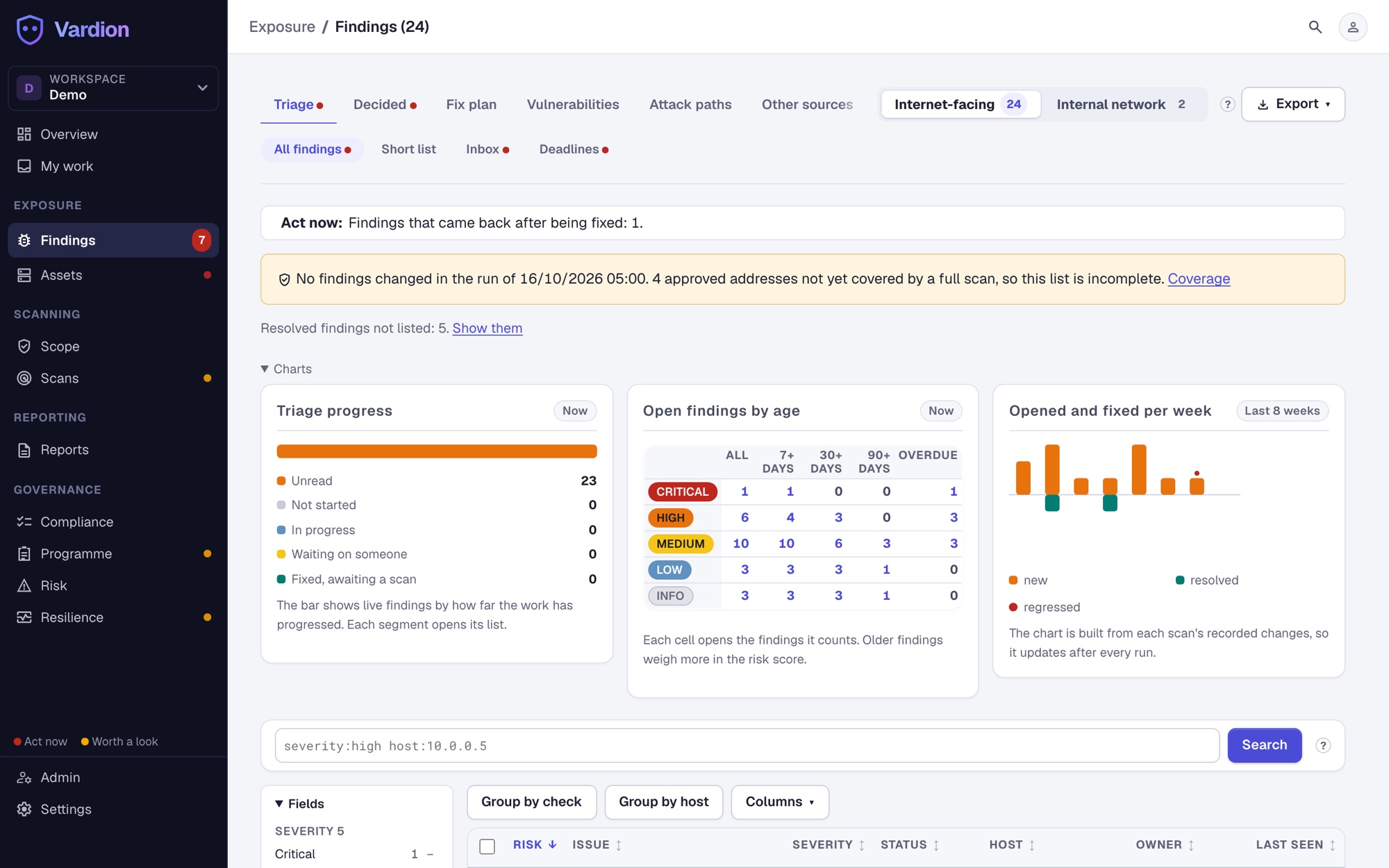
See the systems you forgot you had
New hosts, open ports and certificates are flagged on the next run.
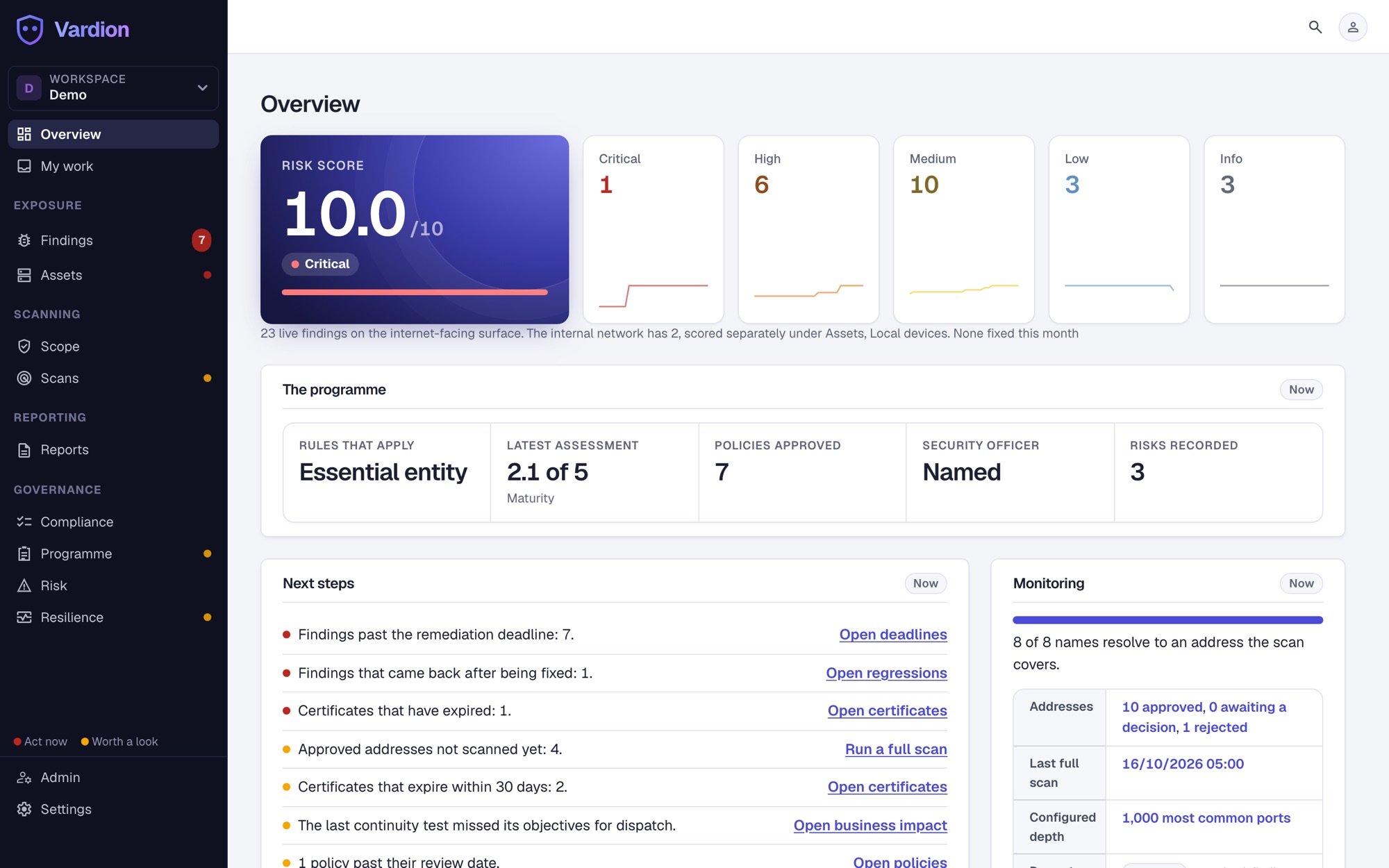
Start with what attackers use first
Every finding gets one score from 0 to 10, weighted by active exploitation, how critical the system is and how long it has been open.
- An owner from your rules and a deadline by severity
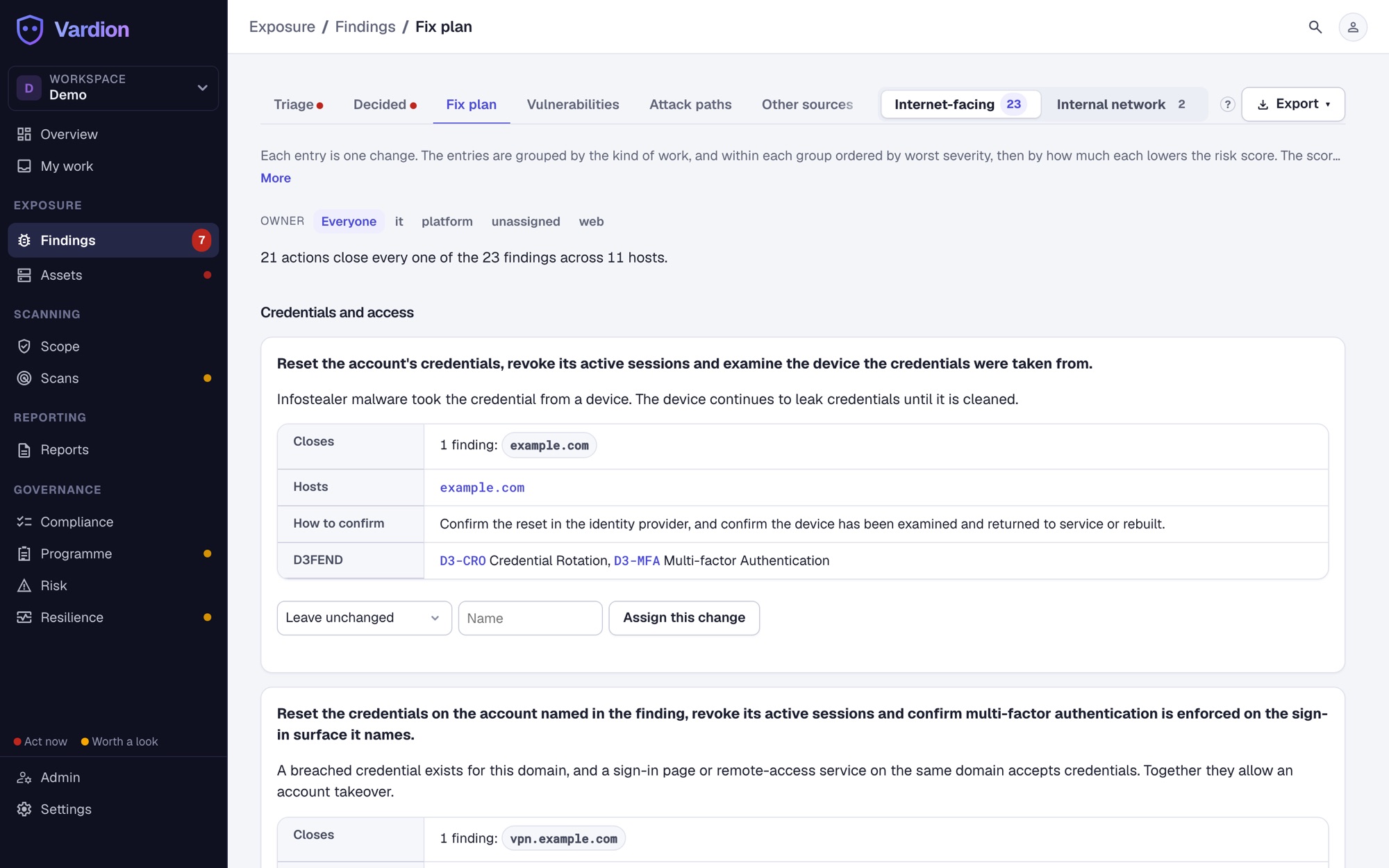
One change, many findings closed
In the fix plan, a firewall rule on 9 hosts is 1 task, not 9.
- Ready configuration lines for nginx and Apache
- A one-host retest that confirms the fix
Coverage
From the perimeter to the code
Stop spoofed email
SPF, DKIM, DMARC, MTA-STS and DNSSEC.
Catch lookalike domains
Ranked by how ready each is to send mail.
Spot leaked credentials
Staff accounts in breaches and infostealer logs.
Harden every website
Headers, cookies, TLS and exposed files.
Fix risky cloud settings
AWS, Azure, Google Cloud, Microsoft 365 and Google Workspace.
Patch outdated software
Linux and Docker packages and common Windows software, from a small agent or the Wazuh agents you already run.
Upgrade vulnerable libraries
JavaScript and Python dependencies in GitHub and GitLab.
Find exposed AI
Model APIs and Ollama servers open without a password.
Accuracy
Fewer false alarms, more fixes
A site that answers every path is reported once, not as 16 exposed files.
- What a scan only identifies, such as the web firewall in front of a site, is recorded on the host and never raised as a finding.
- Each finding shows whether a second method confirmed it.
- A false positive marked once stays closed unless it returns worse.
Safe by design
Safe to run against live systems
Only what you approve
Nothing is scanned until you approve the address, its range or its cloud account. An express run you start approves only addresses with no sign of shared infrastructure.
Gentle by default
Vulnerability checks send at most 50 requests a second per host, with no denial-of-service or intrusive tests.
Industrial ports get only the port scan
S7, Modbus, DNP3 and the other control protocols are reported from it, with no further probe.
Every change recorded
A tamper-evident log of who changed the scope and when.
FAQ
Attack surface questions
We already run a vulnerability scanner. Why add Vardion?
Keep it and connect it: Tenable, Qualys and Defender by API, Nessus, OpenVAS, Burp and any other scanner's CSV as files. Its results join one ranked list, and discovery finds the names your scanner was never pointed at.
Where do the scans run?
On one Linux server of yours with Docker, so scans leave from an address you control. The hosted console takes in your Tenable, Qualys or Defender results from day one.
How is this different from a penetration test?
A penetration tester looks once or twice a year. Vardion watches in between and gives them a ready scope, so the paid days go further.
What exactly does a scan send?
TCP connections to the ports you choose, then web, TLS and vulnerability checks, with every web request carrying the User-Agent Vardion-ASM/1.0. The scan profile lists every setting.
What can attackers see on your domain today?
Find out in under a minute, then choose how to go further.
Partner programme
Run monitoring and compliance for your clients under your own brand.
See the partner programme